Beyond the Beaches: A Heritage Guide to Old Goa and Fontainhas
Most people who fly into Goa never make it more than a mile from the sand. Which is a shame, because twenty minutes inland is one of the most complete Portuguese colonial landscapes left standing in Asia — UNESCO-listed churches, a Latin Quarter older than most of what you’d call an “old town” in Europe, and forts that have watched four centuries of ships come up the Mandovi.
This Goa heritage guide covers the version of the state that doesn’t fit on a postcard.
450 years of Portuguese-Indian history, briefly
Portugal held Goa from 1510, when Afonso de Albuquerque took the city, until 1961 — longer than it held almost anywhere else in its empire, and considerably longer than British rule lasted over the rest of India. That length of time is why Goa doesn’t feel like a briefly-colonised place with a few landmarks bolted on; it feels genuinely hybrid, in its architecture, its food, its surnames, its Sunday mass. Old Goa was once the administrative capital, a city so grand it earned the nickname “Rome of the East,” before repeated epidemics forced the Portuguese to relocate the capital to Panjim in the 18th century — leaving the churches largely as they were, and largely as you’ll see them today.
Old Goa’s UNESCO churches
The Churches and Convents of Goa were inscribed as a UNESCO World Heritage Site in 1986, and two names anchor the list.
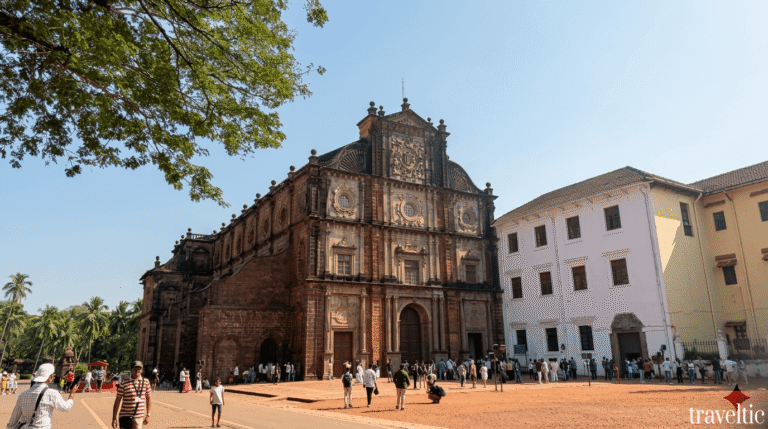
The Basilica of Bom Jesus is Goa’s most visited religious site, largely because it holds the preserved body of St Francis Xavier, the Jesuit missionary and patron saint of Goa. The basilica is a striking example of Baroque architecture, deliberately plain on the outside by design, so the interior comes as more of a surprise.
The Sé Cathedral, just across the square, is one of the largest churches in Asia, dedicated to St Catherine of Alexandria. Its “Golden Bell” is famous for its tone, reputedly one of the finest-sounding bells anywhere in the world.
Practical note: both are working churches, not museums. Shorts and sleeveless tops aren’t permitted inside either building, so dress accordingly.
Fontainhas: wandering the Latin Quarter
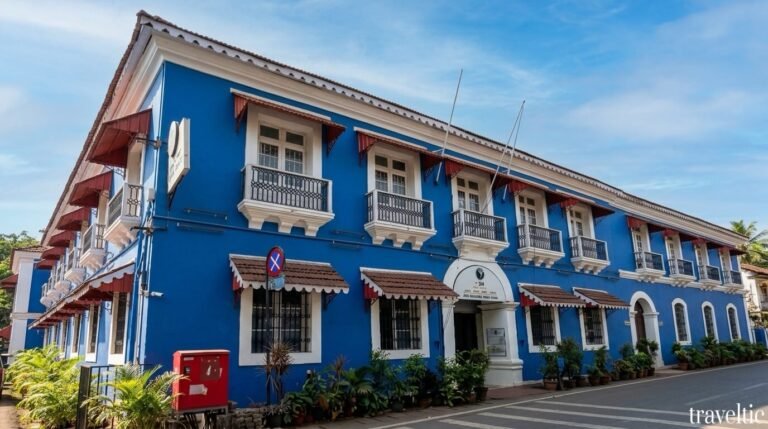
Fontainhas is the oldest and largest Latin Quarter in Asia, named for the natural springs that once ran from the base of Altinho hill (fontainhas is Portuguese for “little fountains”). Wander the lanes and you’ll find pastel-painted villas, the Chapel of São Tomé, and — near the old Government Secretariat — a statue of Abade Faria, the Goa-born pioneer of hypnotism, mid-demonstration on a startled subject. It’s one of the odder public statues in India, and worth the short detour to find.
A quiet ask: Fontainhas is a residential neighbourhood, not a film set. Several residents have flagged, politely but repeatedly, that tourists photographing directly into their homes and doorways without asking has become a real irritation. The lanes are just as photogenic from a respectful distance — there’s no need to point a lens through someone’s open front door.
Spice plantations and the forts
Inland from the churches, a handful of working spice plantations — most clustered around Ponda — run guided walks through pepper vines, cardamom and cinnamon trees, usually finishing with a Goan lunch. It’s a good half-day if you want context for everything you’ve been eating.
Back towards the coast, two forts bookend the Mandovi river’s mouth. Reis Magos Fort, restored and now partly an art gallery, has some of the best river views in Goa and far fewer visitors than its size deserves. Fort Aguada, near Sinquerim, is larger and better known, its 17th-century lighthouse still standing watch where the Mandovi meets the Arabian Sea.
A 2-day heritage itinerary
Day one — Basilica of Bom Jesus and Sé Cathedral in the morning, lunch nearby, then a slow afternoon walk through Fontainhas as the light turns golden. Day two — A spice plantation tour in the morning, Reis Magos Fort for the river view in the afternoon, Fort Aguada at sunset.
Where heritage meets modern Goa
The most interesting thing about this side of Goa is how alive it still is. Old Portuguese villas in and around Fontainhas, Panjim and Assagao have quietly become boutique cafés, bakeries and small guesthouses — restored rather than replaced, original tiled floors and shuttered windows intact. Staying in one, even for a night, is a different experience to a beach resort: mornings start with church bells instead of jet skis.
All that walking earns you an appetite, and this is exactly where Fontainhas’ heritage cafés and Panjim’s old-quarter khanavals overlap — heritage and food aren’t really separate itineraries in Goa. If dishes and market culture are more your thing, our Goan food guide picks up right where this one leaves off. Not sure which side of Goa suits you best? Take our 30-second Goa quiz and find out. [Click here]
What is the Old Goa UNESCO World Heritage Site?
It’s the “Churches and Convents of Goa,” a group of 16th- and 17th-century Portuguese religious buildings — including the Basilica of Bom Jesus and Sé Cathedral — inscribed by UNESCO in 1986.
Why is St Francis Xavier’s body kept in Goa?
St Francis Xavier was a Jesuit missionary who died in 1552; his body was brought to Goa and enshrined in the Basilica of Bom Jesus, where it remains one of the most venerated Christian relics in Asia.
What should I wear to visit Goa’s churches?
Modest dress is required inside both the Basilica of Bom Jesus and Sé Cathedral — shorts and sleeveless tops aren’t permitted, so shoulders and knees should be covered.
Is Fontainhas worth visiting?
Yes — it’s the oldest and largest Latin Quarter in Asia, with pastel Portuguese-era villas and narrow lanes largely unchanged for centuries. It’s best explored on foot, respectfully, since it’s a lived-in residential area.
How many days do I need for Goa’s heritage sites?
Two days covers the essentials comfortably: Old Goa’s churches and Fontainhas on day one, a spice plantation and the forts on day two.
What’s the difference between Reis Magos Fort and Fort Aguada?
Reis Magos is smaller, restored and quieter, with strong river views and an art gallery inside. Fort Aguada is larger, better known, and includes a still-standing 17th-century lighthouse at the coast.